Research
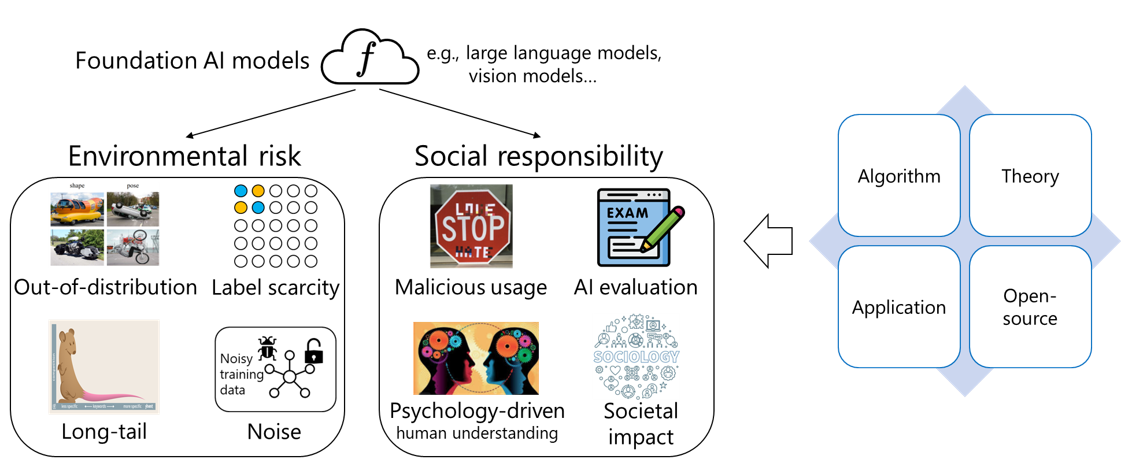
The long-term research goal is to understand and improve modern AI models (e.g., pre-trained models, large language models, and multimodal models). We create new theory, algorithms, applications, and open-sourced library to achieve our goal. The following lists some of the key research focuses and my full publications can be found at Google Scholar.
You are welcome to read the annual review of my research: 2025, 2024, 2023.
- Philosophy of language models: understand how LMs work and their limitations.
- Direction 1: AI Evaluation Science, which studies benchmarks, protocols, frameworks, and science for AI evaluation. See our high-level evaluation research overview. Related papers: ADELE (Nature), KnowledgeSmith (ICLR’26), SparseEval (ICLR’26), DyVal (ICLR’24 spotlight), DyVal2 (ICML’24), PromptBench (JMLR’24), LogicEval (ACL’25), StringLLM (ICLR’25), ValueCompass (ACL’25), PromptRobust (CCS LAMPS).
- Direction 2: AI Personalization and Alignment, including personalized LLM safety, alignment, and post-training. Related papers: Classroom AI (Nature AI’26), PENGUIN (NeurIPS’25), CultureVLM (CVPR’25 w), CultureLLM (NeurIPS’24), CulturePark (NeurIPS’24), CAReDiO (ICML’26).
- Direction 3: Agentic AI, which studies the architecture, system, and applications of LLM agents. Related papers: AgentArk, Topology Agent. I’m especially interested in interdisciplinary research, e.g., AI+economics: CompeteAI (ICML’24 oral), AI+psychology EmotionPrompt (ICML’24), AI+peer review: AgentReview (EMNLP’24 Oral), AI+research: CycleResearcher (ICLR’25), AI+society: CMASE, AI+mental health: MentalArena.
- Machine learning with foundation models: I’m generally interested in designing algorithms to make AI systems more robust, trustworthy, and responsible.
- Direction 1: Consistent Unified Multimodal Models (Position paper), which studies how to make unified multimodal models more consistent and unified. Related papers: UniGame (CVPR’26), xLARD (CVPR’26), FairUMM (NeurIPS’25), UMM (AAAI 26), TorchUMM, UniPath, LatentUMM, FedUMM (WWW’26)
- Direction 2: Catastrophic Inheritance (Vision paper (DMLR’24)), which studies how pre-training bias/noise/bad data influence downstream tasks and how to mitigate it. Related papers: Noisy model learning (ICLR’24 spotlight), Noisy diffusion pre-training (NeurIPS’24 spotlight), Bias inheritance (ACL’26 Oral), Noisy foundation model (TPAMI’25), Medical CI (NeurIPS’25).
- Direction 3: Trustworthy ML, which generally builds safe and responsible ML algorithms with the help of foundation models (not a new direction; but for many years). Recent and popular papers: HAROOD (KDD’26 Oral), CAT-Video (ICLR’26 workshop), Masked autoencoder (ICML’25 spotlight), SoftVQ-VAE (CVPR’25), FlexMatch (NeurIPS’21).
- Additionally, my research also spans machine learning, transfer learning, OOD, federated learning, and many other topics. Previous other impactful papers: FlexMatch (NeurIPS’21), Diversify (ICLR’23), AdaRNN (CIKM’21), MEDA (MM’18)
Media Coverage
- Building Federated Multimodal AI Workflows with NVIDIA FLARE, NVIDIA Technical Blog. August 2026. [Webpage]
- Large language models and prompt engineering, Epsiloon. April 2026. [Webpage]
- William & Mary Professor Wins Dual Research Awards from Google and Amazon Web Services, William & Mary News. November 2025. [Webpage]
- NeurIPS 2024 with Jindong Wang and Steven Euijong Whang, Microsoft Research Podcast. December 2024. [Webpage] [Youtube]
- The Answer To Why Emotionally Worded Prompts Can Goose Generative AI Into Better Answers And How To Spur A Decidedly Positive Rise Out Of AI, by Forbes. November 2023. [Webpage]
- CulturePark for low-resource large language models, by MIT Technology Review. June 2024. [Webpage]
- Epic and Generative AI, by Epic. December 2024. [Webpage]
- Unveiling the Power of Semi-Supervised Learning: The Unified Semi-Supervised Learning Benchmark, by Pytorch. May 2024. [Webpage]
- EmotionPrompt in RAG, by LlamaIndex. August 2023. [Webpage]
- Exploring the effects of emotional stimuli to large language models, by TexExplore. September 2023. [Webpage]
- CompeteAI: An Artificial Intelligence AI Framework that Understands the Competition Dynamics of Large Language Model-based Agents, by Daily.dev, July 2024. [Webpage]
Funding and Grants
- PI. Gemini Academic Research Award. 2026 - 2027.
- Co-PI. The Commonwealth Cyber Initiative (CCI) Experiential Learning Project. 2026.08 – 2027.07.
- PI. Google Awards for Machine Learning Research and Education with TPUs. 2026 - 2027.
- PI. Lambda Research Grant Program. 2026 - 2027.
- PI. NVIDIA Academic Grant Program. 2026 - 2027.
- PI. Amazon Research Award. 2026 - 2027.
- PI. Google DeepMind Unrestricted Gift Award. 2025 - 2026.
- PI. AMD University Program AI&HPC Award. 2025 - 2026.
- PI. Google Cloud Research Credit Award. 2025 - 2026.
- PI. Modal academic compute grant. 2025 - 2026.
- PI. Cohere Labs Catalyst Grant. 2025 - 2026.
- PI. William & Mary Faculty Travel Grant. 2025.
- PI. William & Mary Faculty Research Award. 2025.
- PI. Microsoft Accelerate Foundation Model Research grant. 2025.02 – 2025.06.
- Co-PI. The Commonwealth Cyber Initiative (CCI). 2025.03 – 2026.02.